
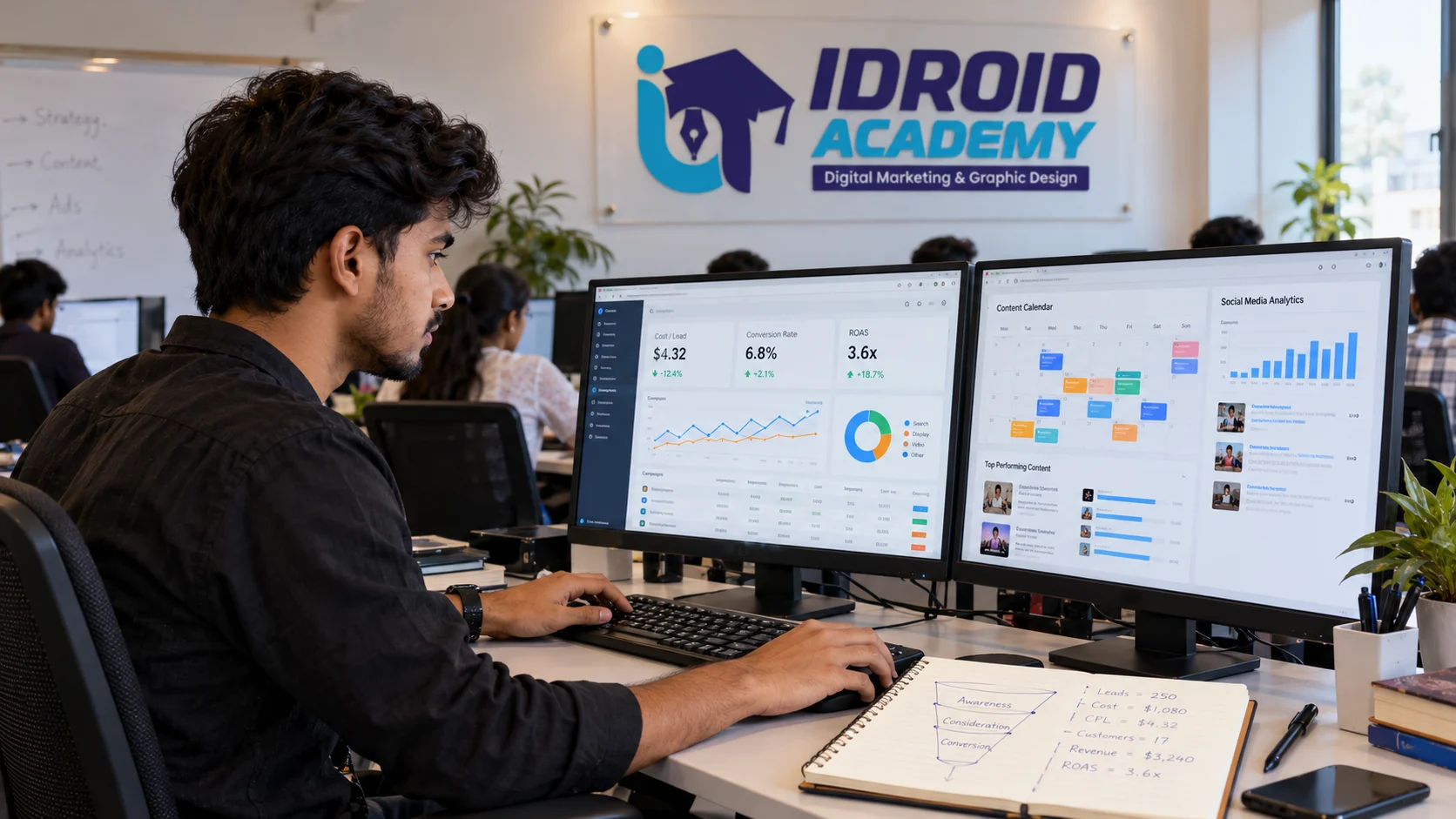
Open any marketing job portal in India and you will see two labels that look almost identical: digital marketing and performance marketing. Course brochures use both. Agencies use both. If you are comparing a performance marketing course with a general digital marketing program, it helps to know exactly where one ends and the other begins, because the skills, the pay structure, and the daily work are not the same.
The short version: performance marketing is a part of digital marketing, not a rival to it. But that short version hides a lot, so this guide goes through the real differences, the numbers each side cares about, and what to look for if you are searching for a performance marketing institute near me.
The Quick Answer
Digital marketing is every way a business reaches people online: search engine optimization, social media, email, content, and paid ads. Performance marketing is the part of that work where you pay only when a defined action happens, such as a click, a form fill, a call, or a sale, and where every rupee can be traced to a result.
Think of digital marketing as the whole shop and performance marketing as the till. The shop includes the window display, the signboard, the word of mouth, and the sales counter. The till is where you can see exactly what came in.
What Digital Marketing Covers
Digital marketing is the broader field. It includes:
- SEO, which earns visibility in search results without paying per click. If you want the full picture, this SEO full course overview explains what each module covers.
- Social media marketing, both the free posting side and the paid side.
- Content marketing, such as blogs, videos and guides that attract and educate people.
- Email marketing, which brings existing leads and customers back.
- Paid advertising, including search ads, display ads and social ads.
- Analytics and reputation management, which tell you what is working and how the brand is seen.
A lot of this work builds slowly. A blog post written today may not bring a single visitor for weeks. A social media page grows over months. None of that is a flaw. It is how brand recognition and trust are built, and it keeps paying back after the effort is done.
What Performance Marketing Means
Performance marketing is built around one idea: you pay for outcomes, and you can prove them. Google’s own guidance on conversion tracking explains why this matters. A conversion is recorded when someone interacts with your ad and then completes an action you decided was valuable, and tracking it is what shows you which keywords, ads and campaigns are producing results for your business and which are just spending money.
That tracking is what separates performance marketing from simply running ads. A campaign with no conversion tracking is advertising. A campaign where you can say “this ad group produced 14 enquiries at this cost, and that one produced 2” is performance marketing.
The common payment models are:
- Cost per click (CPC): you pay each time someone clicks.
- Cost per lead (CPL): you pay, or measure cost, per enquiry or sign-up.
- Cost per acquisition or sale (CPA): you measure what it cost to win one customer or order.
The channels are mostly paid ones: Google Search and Display ads, Meta ads on Facebook and Instagram, YouTube ads, and affiliate arrangements where partners earn only when a sale happens.
Performance Marketing vs Digital Marketing: Side by Side
| Aspect | Performance Marketing | Digital Marketing (whole field) |
| Scope | A results-driven subset of paid and measurable activity | All online marketing, paid and organic |
| Money flow | Spend is tied to a defined action | Mix of upfront effort, fixed costs and paid media |
| Main numbers | CPA, ROAS, conversion rate, cost per lead | Traffic, rankings, reach, followers, plus conversions |
| Speed | Can start producing data within days | Ranges from days (ads) to months (SEO, content) |
| Typical roles | PPC specialist, paid social specialist, growth marketer | Digital marketing executive, SEO specialist, social media manager, content specialist |
| Biggest risk | Burning budget on traffic that never converts | Spending months on activity that is hard to link to sales |
| Best for | Leads, sales, app installs, quick testing | Brand building, long-term traffic, steady audience growth |
If you are curious how these roles are paid at different experience levels, the breakdown in Digital Marketing Jobs in 2026: Roles, Salaries, and Career Growth is a useful companion read.
The Numbers Each Side Watches
This is where the two paths feel different in daily work.
A digital marketer working on SEO or content looks at rankings, organic traffic, time on page, followers and reach. These are signs that a brand is becoming easier to find and more familiar.
A performance marketer looks at a tighter set of figures:
- Conversion rate: out of everyone who clicked, how many did what you wanted.
- CPA or cost per lead: what one result costs.
- ROAS (return on ad spend): how much revenue came back for every rupee spent on ads.
- CTR (click-through rate): how often people who saw the ad clicked it.
Here is a simple illustration, not real data. Suppose a coaching business spends ₹10,000 on ads in a week and receives 20 enquiries. The cost per lead is ₹500. If the landing page is improved and the next ₹10,000 brings 30 enquiries, the cost per lead drops to about ₹333 for the same budget. A performance marketer lives in that loop: change one thing, measure, repeat.
Where Google Ads Fits In
For most beginners, Google Ads is the first performance marketing tool they touch, because search ads put your offer in front of someone who is already looking. Setting up a campaign means choosing a goal, picking keywords, writing ads, setting a budget and bidding approach, and, most importantly, installing conversion tracking before spending anything meaningful. A step-by-step walkthrough is available in this guide on how to run your first Google Ads campaign.
Meta Ads works differently. Instead of catching a search, it reaches people by interests and behavior while they scroll. The Meta Ads full course guide for Facebook and Instagram covers its campaign structure and objectives in detail. Both platforms belong in a performance marketer’s toolkit, and each has its own way of reading results. A well-rounded learner picks up both, plus basic analytics, so they can tell whether a lead from either channel was worth the cost.
Skills a Performance Marketer Actually Needs
Based on how the work runs day to day, these are the skills that matter most:
- Campaign setup and management on Google Ads and Meta Ads, including audience targeting and budget control.
- Conversion tracking and analytics, so you can read the data after the click and find where people drop off.
- Testing habits, since ad copy, creatives, audiences and landing pages all need to be compared against each other.
- Spreadsheet comfort, because CPA, ROAS and budget pacing are simple calculations that you will do constantly.
- Copywriting and basic design sense, because a well-managed budget cannot rescue a dull ad or a confusing landing page.
- SEO and content awareness, since paid traffic is more expensive when the website itself is weak. The SEO Specialist course is one way to build this side properly.
Notice the last point. Performance marketing sits on top of the wider digital marketing base. People who skip that base often manage campaigns well on paper but cannot explain why a landing page is losing visitors.
Common Mistakes Beginners Make
Chasing cheap clicks. A click that costs less but never turns into an enquiry is the most expensive click you can buy.
Launching without tracking. If conversions are not recorded, you cannot compare campaigns, and every decision becomes a guess.
Judging a campaign too early. A few hours of data is not enough. Constant changes make it impossible to know which change helped.
Ignoring the landing page. The ad is only half the path. If the page it opens is slow, unclear or unrelated to the ad, the budget is wasted at the last step.
Treating all platforms the same. What works on Google Search rarely carries over unchanged to Instagram.
Should You Learn Performance Marketing First or Digital Marketing First?
For most beginners, learning the wider digital marketing base first, then specializing in paid media, gives better results than jumping straight into ads. Here is why. A performance marketer who understands SEO knows why some landing pages convert better. One who understands content writes stronger ad copy. One who reads analytics catches problems before the budget is gone.
If you already work in a business and run ads for it, you may go the other way: start with the paid side because the need is immediate, then fill in SEO and content later. Both orders work. What does not work is learning platform buttons without understanding what the numbers mean.
Choosing a Performance Marketing Course or Institute
If you are searching for a performance marketing institute near me, a few questions will help you compare options honestly:
- Will you run real campaigns, or only watch demonstrations? Live, client-style projects teach you far more than slides.
- Does the course cover tracking and analytics, not just ad setup? Setup is the easy part.
- Does it include the surrounding skills, such as SEO, content and social media?
- Is there help with resumes, interviews and portfolio building? Employers in this field look at what you have actually run.
- Are batch timings workable if you are a student or already employed?
One straightforward note on how courses are packaged. Many institutes in Bhopal, including iDroid Academy, do not sell performance marketing as a separate standalone program. Instead, the paid advertising skills sit inside a complete digital marketing curriculum, which is also the order of learning most beginners benefit from. You can compare this with the other programs on the all courses page.
How iDroid Academy Covers the Performance Marketing Side
iDroid Academy’s Digital Marketing course in Bhopal runs for 3 months with 2 hours of classes each day. The curriculum covers SEO, Google Ads and PPC, Social Media Marketing (including ad campaigns), Content Marketing, Email Marketing, Google Analytics and Search Console, and Online Reputation Management. The Google Ads and PPC module focuses on setting up and optimizing paid search and display campaigns, and the tools students work with include Google Ads, Google Analytics, Meta Business Suite, Canva and Photoshop for campaign assets. Anyone who wants to go deeper on the paid social side can also look at the Social Media Marketing course.
The institute lists flexible batch timings for students and working professionals, hands-on project work, and placement support that includes resume building, mock interviews and access to its industry and alumni network. It is located in Zone-I, MP Nagar, Bhopal, and the academy says it is easy to reach from Arera Colony, Habibganj, Kolar Road, New Market, Bairagarh, Govindpura and Hoshangabad Road. Students from nearby towns such as Sehore and Vidisha also attend, according to its website.
The roles the course points toward include Digital Marketing Executive, PPC or Google Ads Specialist, Social Media Manager, SEO Specialist and Content Marketing Specialist, so you can try several areas before deciding whether paid media is where you want to go deeper.
Frequently Asked Questions
Is performance marketing the same as PPC?
No. PPC is one payment model inside performance marketing. Performance marketing also includes cost per lead, cost per acquisition and affiliate setups, and it extends to paid social as well as search.
Is performance marketing part of digital marketing?
Yes. Digital marketing is the larger field, and performance marketing is the measurable, pay-for-results portion of it.
Can a beginner start with performance marketing directly?
You can, but it works better when you also understand SEO, content and analytics, because those skills explain why campaigns win or lose.
Which is better for a business, performance marketing or digital marketing?
Most businesses need both. Paid campaigns bring quick, trackable leads, while SEO and content build traffic that keeps arriving without ad spend.
Do I need to know coding or advanced math?
No. You need comfort with basic arithmetic, spreadsheets and reading dashboards. Ad platforms handle the technical side.
How do I know if an institute is teaching real performance marketing?
Ask whether students run live campaigns, whether conversion tracking is taught from the first ad, and whether you will practice reading results and adjusting budgets rather than just creating campaigns.
Learn It With Real Campaigns
If you want to understand performance marketing by running campaigns instead of reading about them, the Digital Marketing course at iDroid Academy in MP Nagar, Bhopal is a practical place to begin. You can call +91 9589674037, write to info@idroidacademy.com, or book a free demo session to see the curriculum before you decide. The academy is at Plot No. 61, 3rd Floor, Near Shree Vatika Hotel, Zone-I, MP Nagar, Bhopal.